 EN
EN
 French
 Portuguese
 Spanish
Phase
Capsule
Tech
Combining two active ingredients within one dosage form seems conceptually easy – combine ingredients, fill capsule, achieve designated dose. However, not all combinations function in this fashion. When components interact such as in phase transitions, moisture migration between phases, or one component catalytically increases the degradation rate of another; then having such components in direct contact with each other will alter one or more components potency, stability, physical appearance or shelf-life.
This becomes ingredient compatibility during formulation of a nutraceutical product which becomes a crucial consideration in dosage-form design.
This blog will guide you more about multi-phase formulation of capsules.
Why Can't Some Nutraceutical Ingredients Simply Be Blended Together?
Ingredients react with each other via various means such as interaction through moisture transport, oxidation, chemical interactions, and physical changes. A frequent one that is encountered is a lipophilic or an oil-based active material combined with a moisture-sensitive or hygroscopic powder. Due to the direct contact, the moisture-sensitive powder may end up immersed in a liquid medium wherein it experiences changes in physical properties or degradation rate.
Additionally, oxidative-sensitive ingredients should be protected against oxidation or reactive substances.
During stability testing, we look for factors such as temperature, humidity, oxidation, and light since these factors hasten degradation. Therefore, a poorly compatible active ingredient supplement will not have a visible effect immediately post-manufacturing. The effect of incompatible interactions will only be expressed during storage.
Warning Signs of an Ingredient Compatibility Problem
Oxidation Risk Between Oil and Powder Phases
Some oils and lipid components are prone to oxidation. If the oil has oxidation-prone components, then heat, oxygen, light, or other reactive materials can cause breakdown. This might be especially apparent if the oil phase is added directly to powders with potentially reactive ingredients or moisture. The objective is not to prevent reactions in all oils and powders, but rather to understand if there is an issue measured as instability.
Moisture Transfer to Hygroscopic Ingredients
Hygroscopic powders are capable of picking up water from their environment. A liquid phase in a formulation or a capsule shell with high water content may also deliver moisture to a formulation with sensitive ingredients, causing both physical and chemical instability. Moisture is a critical component in assessing pharmaceutical stability, especially when compounds undergo hydrolysis or physical degradation. This is why an oil-and-powder separated capsule is considered when separation allows both components to remain stable.
Changes in Potency, Colour, Odour or Physical Appearance
Problems in compatibility don’t have to manifest as a vigorous chemical reaction. During development or stability testing, the formulator might notice:
- Change in active potency
- Appearance of degradation products
- Change in colour
- Change in odor
- Powdery clumps / agglomeration
- Change in fill viscosity
- Shell bursting / leaking, shell integrity problems
A change observed in a stability study does not automatically prove two actives are incompatible, but it is a notification that an investigation should be conducted.
How Is Ingredient Compatibility Actually Tested?
Tests should be conducted to verify compatibility of any new materials before choosing a novel capsule system. Often a formulation team will review each proposed ingredient and combinations of ingredients, as well as their physicochemical characteristics. Depending on the formulation, this could involve stress or accelerated testing, moisture exposure, assessment of oxidation, physical inspection of the material, and analytical checks for active content and degradation.
When Is a Multi-Phase Capsule the Right Choice?
Not all combination products necessitate a high-tech capsule form. Any combination can be formulated with a traditional capsule where stability data supports that they will not interact and the formulation will hold its specifications over the designed shelf life. The capsule-in-capsule ingredient approach applies when:
- Two ingredients demonstrate an observable interaction in a combination formulation.
- It is necessary to separate an oil and a powder.
- It is necessary to protect a moisture-sensitive ingredient from a different phase of the formula.
- It is necessary to deliver a formula in two separate release stages.
- Two formulations need two distinct excipient systems.
- A brand requires two discrete phases of delivery inside a single unit dose.
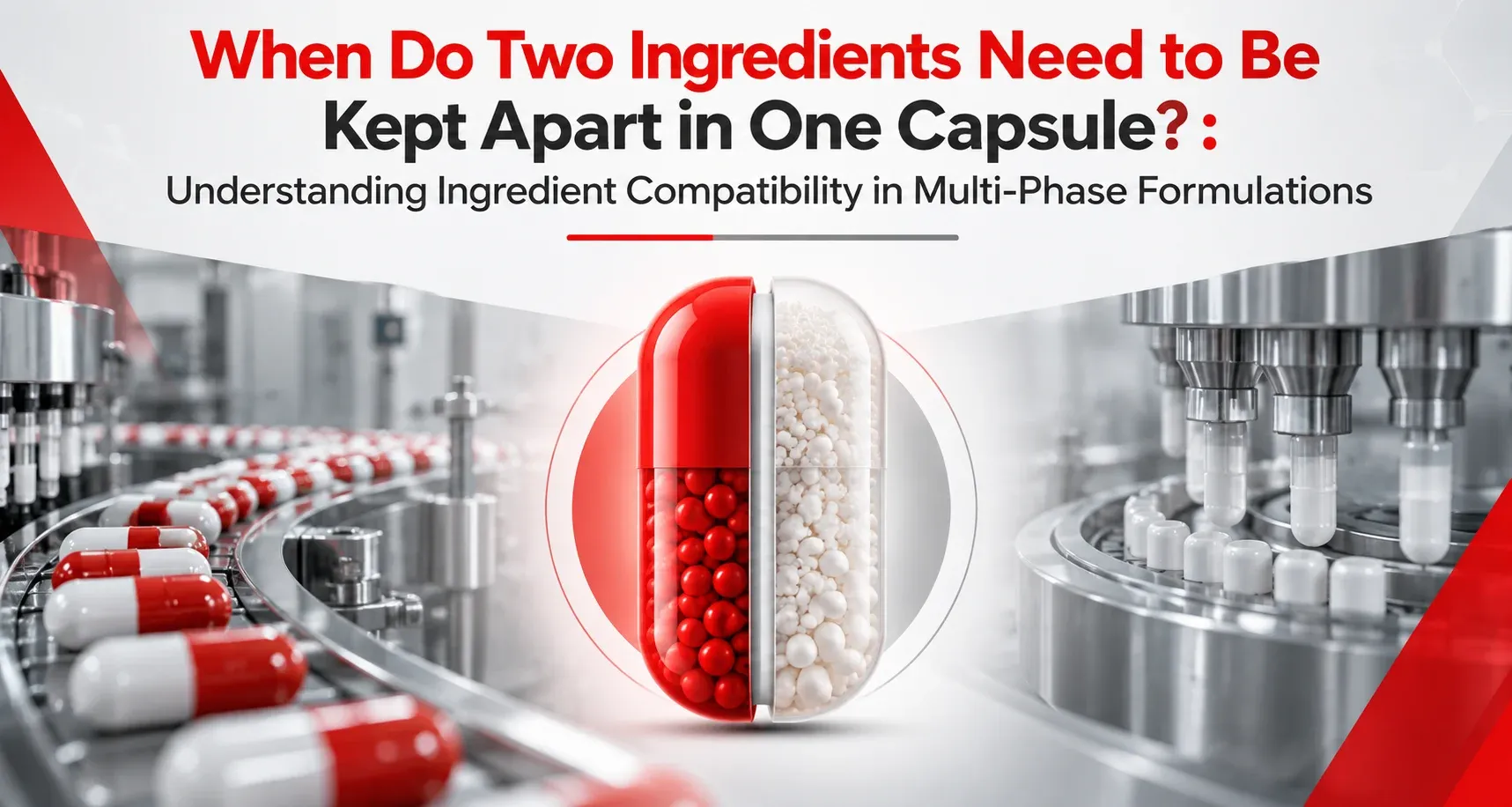
Capsule-in-capsule technology allows us to deliver combinations that would otherwise separate physically while remaining as a single dose, such as a powder-and-oil combination. The key is that separation should address a formulation challenge rather than solely a marketing goal.
What Should You Bring to a Compatibility Discussion?
Prior to your discussions with a formulation or manufacturing team, have this information ready:
- Ingredient list: A full list of ingredients including all active components, extracts, oils, excipients, and percentages.
- Known potential stability problems: Details such as sensitivity to moisture, oxidation, light, and temperature.
- Target shelf life & storage conditions: The required duration for which the supplement must remain within specification.
- Desired release profile: Clarification on whether ingredients need simultaneous or phased release.
- Capsule preference: Target capsule material and size, vegetarian/vegan requirements, and branding preferences.
- Any available stability information: Results from lab or pilot batches, noting any changes in potency, colour, or odour.
Once the formulation team receives these details, they can decide whether it is feasible for a simple blend, a separate fill, or a multi-phase form.
Build the Right Choice Around Your Formulation
When two actives aren’t suitable for direct combination, withdrawing an ingredient isn't the only option. Often, a physically separated formulation allows both actives within a single dosage unit while limiting interactions and allowing separate release characteristics. The correct technique comes from a thorough nutraceutical ingredient compatibility assessment followed by appropriate storage and suitable capsule architecture. When two actives interact, our team can conduct compatibility testing on your formulation to help you choose the ideal delivery system.
Get guidance from the R&D and formulation experts at Agnivesh. Our technical team is ready to evaluate your active ingredients and propose the optimal multi-phase solution.
Frequently Asked Questions
No. When compatibility and stability studies show that ingredients are acceptable to co-exist with limited degradative effects, a simple capsule would suffice.
There is no set rule. This is dependent on formulation, test design, analytical methods, storage conditions, developmental stage etc. While initial screening is helpful, long-term stability studies take significantly longer.
Yes. While degradation can occur as and when it’s triggered, it can also occur over prolonged periods of time to reach a significant measurement.
No. These methods allow for different formulation outcomes. Capsule-in-capsule is about separating two formulations within a single dosage form, unlike an enteric coat that is usually formulated to delay absorption once within an environment to which it is appropriate for.