 EN
EN
 French
 Portuguese
 Spanish
Shell
Guide
HPMC/Gel
When creating a liquid-filled nutraceutical, selecting the capsule shell material can be much more than a packaging decision. The shell needs to contain the liquid or semi-solid fill and keep it contained through storage, withstand manufacturing and packaging process conditions, enable effective sealing, and must be physically and chemically compatible with the formulation.
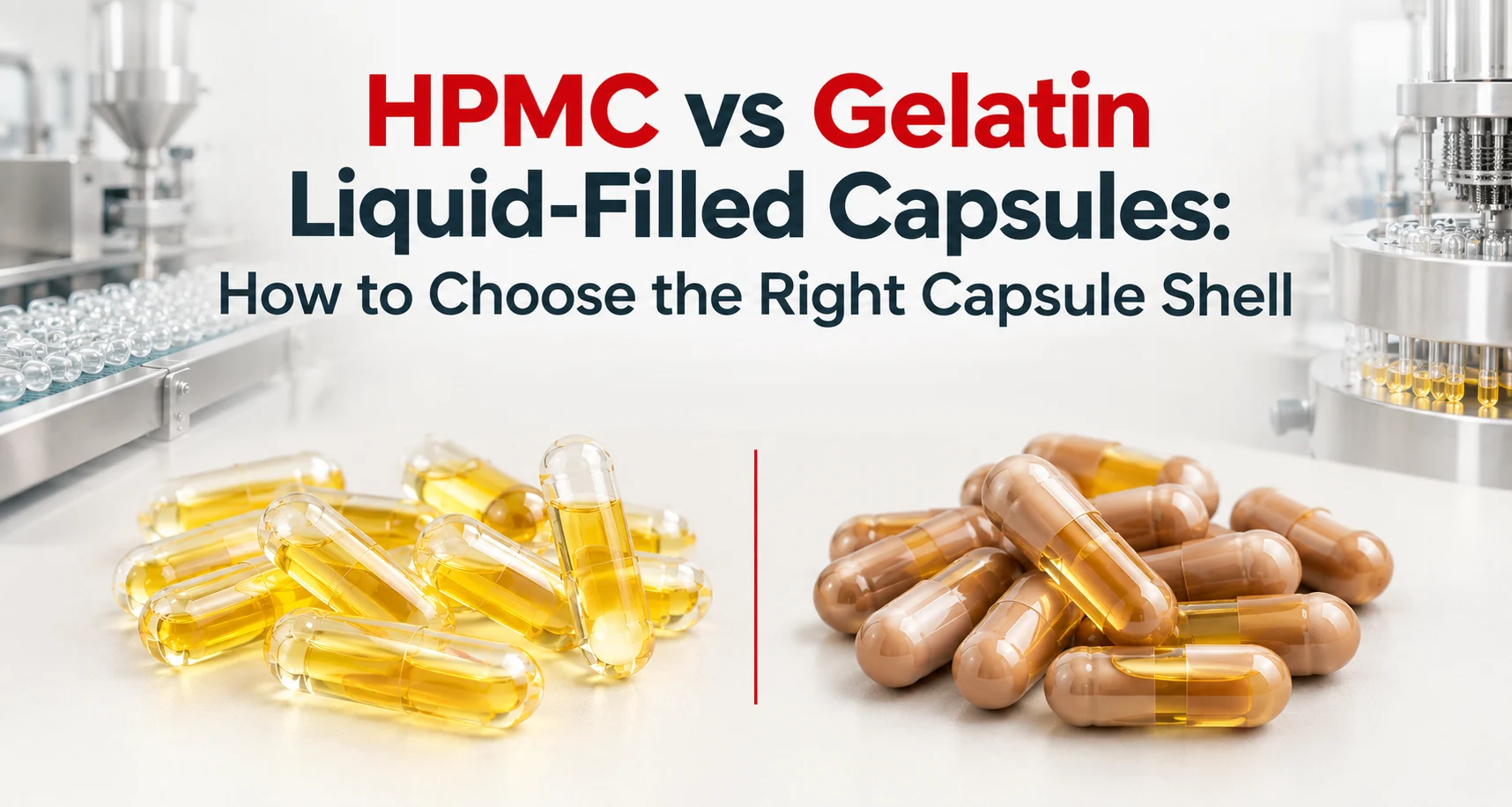
The most frequent material choices are gelatin (animal source) and HPMC (plant derived). Both types of shells are commonly used for liquid-filled hard capsules, but each has distinct physical and biological properties relevant for formulation choice and market fit.
This blog will explore the comparison of HPMC and Gelatin to help you choose the right capsule shell for your product line.
What Does a Liquid-Filled Capsule Shell Need to Do?
The purpose of a liquid-fillable capsule shell is to:
- Hold liquids, oils, suspensions, or semi-solid formulations without seeping or leaking out of the shell.
- Have sufficient mechanical integrity to endure filling, handling, transit, and storage.
- Be physically and chemically compatible with the active substances and excipients.
- Ensure reliable sealing or banding once fill has been placed inside.
- Retain acceptable levels of disintegration and targeted active release.
Oils, suspensions, self-emulsifying systems, thixotropic formulations, and select semi-solids can be placed in a liquid-fillable hard capsule. However, not every liquid is acceptable with every capsule shell, making the appropriate choice of shell material essential.
Gelatin Capsules: The Established Choice for Liquid Fills
Gelatin continues to be the most prevalent capsule shell formulation due to processing advantages, ready availability, and low cost. It is produced by processing collagen into a finished capsule shell form; typically, these capsules are intended for use with pharmaceutical or nutraceutical products.
Gelatin may be the simplest solution for certain conventional oil-based formulations where vegetarian/vegan positioning is not necessary.
Shells made from gelatin contain significantly more water than HPMC shells. The moisture content in a hard gelatin capsule is normally about 13% to 16% under standard storage conditions, which may be significant for hygroscopic ingredients or chemically reactive compounds. Gelatin is also attractive when unit cost is the primary consideration.
HPMC Capsules: A Plant-Based Alternative
HPMC (hypromellose) is a cellulose-derived polymer utilized in non-gelatin capsule shell manufacturing. It is extensively applied when a brand seeks a vegetarian or vegan-friendly positioning. One of the main advantages of HPMC capsule shells is their lower water content—typically between 3% and 8% depending on capsule specifications.
HPMC capsules greatly benefit water-sensitive or highly hygroscopic formulations. Furthermore, HPMC is less likely to undergo cross-linking, a phenomenon observed in gelatin shells over time when exposed to aldehyde-forming compounds. This is particularly important for maintaining long-term dissolution performance.
Vegetarian, vegan, clean-label, Halal, and Kosher-oriented brands gain a powerful positioning advantage by selecting HPMC. However, compliance must be confirmed with the specific capsule supplier and specification sheet.
HPMC vs Gelatin: Which Factors Matter Most?
Moisture Sensitivity & Formulation Stability
Hygroscopic and moisture-sensitive actives/excipients benefit from lower shell moisture associated with HPMC formulations. While gelatin remains appropriate for many stable oils, gelatin shells can be affected by highly hygroscopic vehicles. Compatibility testing prior to commercialization is mandatory.
Vegetarian, Vegan, and Religious Positioning
For vegetarian/vegan markets, HPMC is the preferred option as it avoids animal gelatin. If your gelatin source meets specific requirements, you may produce capsules acceptable for certain Halal and Kosher markets, but certifications must be verified with the supplier.
Cost and Manufacturing Considerations
Gelatin is typically the proven, cost-effective alternative for traditional applications. HPMC may carry higher material or manufacturing costs. However, shell cost is only part of the equation—reformulations, shelf-life extensions, rejection rates, and market pricing all impact the overall financial return.
Compatibility With the Liquid Fill
Both HPMC and gelatin work for various liquid fills—including oils, suspensions, thixotropic systems, thermosoftened formulations, or self-emulsifying systems (SEDDS). You cannot presuppose compatibility: fill viscosity, filling temperature, and shell interaction must be tested.
A Practical Framework for Liquid-Filled Capsule Shell Selection
To select from broad capsule shell options, evaluate these four core questions:
- Target Audience: Is vegetarian, vegan, or clean-label positioning paramount? If so, HPMC is your starting point.
- Moisture Sensitivity: Is the active degraded by water? Low-moisture HPMC shells are recommended.
- Fill Characteristics: Is the fill a simple oil, suspension, thixotropic matrix, or self-emulsifying system?
- Manufacturing Facility Parameters: Filling temperature, viscosity, capsule size, banding sealing lines, and target shelf-life.
Choose the Right Shell for Your Liquid-Filled Formulation
Neither material is universally superior. For typical liquid fills, gelatin is a simple and economical choice, whereas HPMC excels for vegetarian positioning and moisture-sensitive actives. The ultimate decision is guided by fill compatibility, active stability, consumer preferences, required certifications, and cost targets.
Consult the formulation experts at Agnivesh to discuss HPMC vs. Gelatin liquid-filled capsule manufacturing and our full line of liquid-filled capsule development, filling, sealing, and contract manufacturing services.
Frequently Asked Questions
No. Gelatin is typically the more economical choice, but overall cost depends on specifications, supplier, quantity, formulation challenges, and manufacturing yield.
Not always. What is stable in a gelatin shell may behave differently in an HPMC shell, and vice versa. Compatibility and stability testing must be conducted.
Yes, it can. This depends on factors like shell moisture content, shell-fill interactions, storage conditions, packaging barrier, and overall ingredient stability.
Yes, gelatin shell material can be Halal and Kosher compliant provided you verify certifications, animal sourcing, and facility audit controls with your capsule supplier.