 EN
EN
 French
 Portuguese
 Spanish
Certified
Quality
AHCC
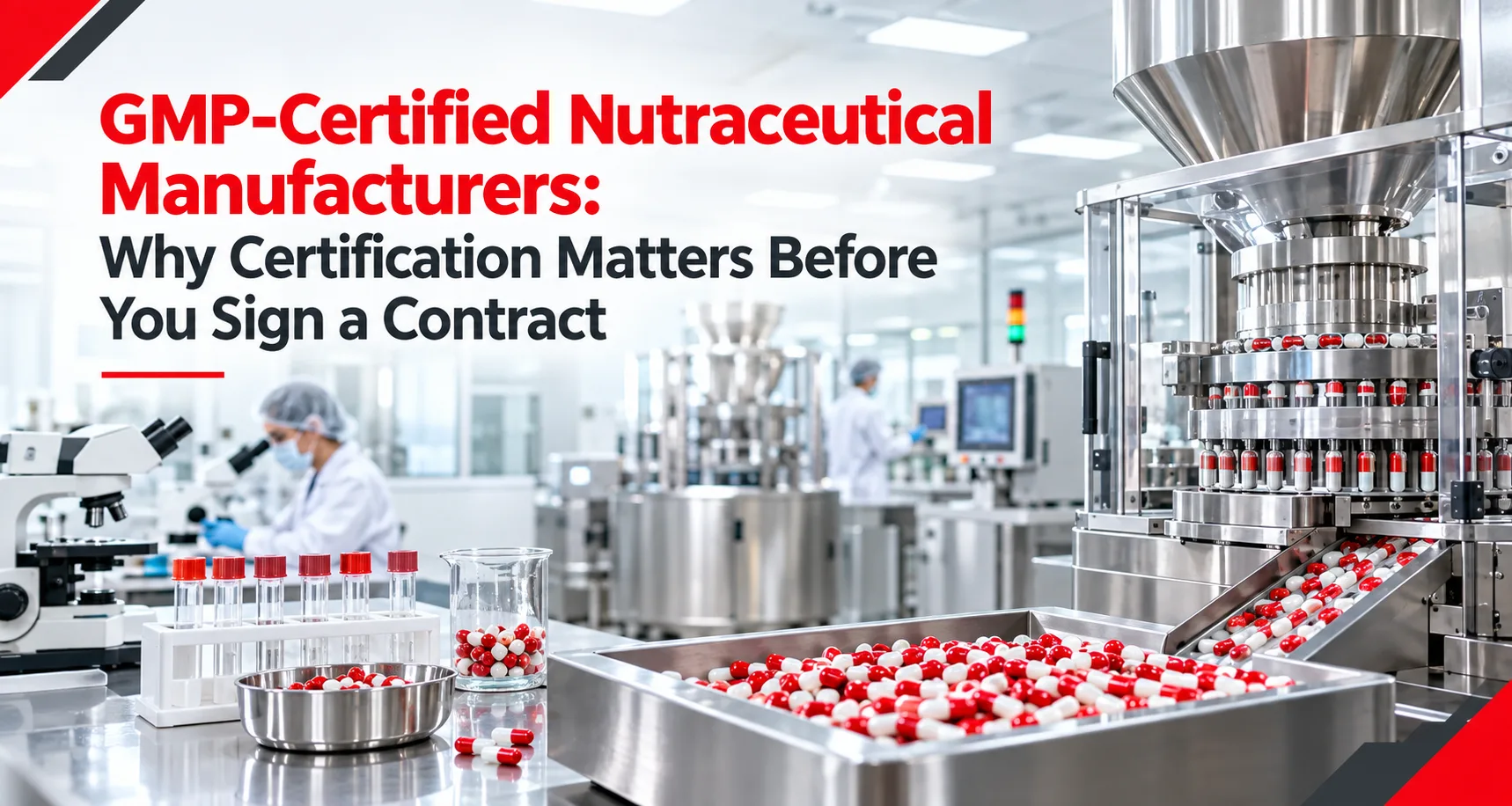
A GMP (Good Manufacturing Practices) approved nutraceutical manufacturer maintains documented quality procedures that ensure consistent production, hygiene, testing, and full batch traceability.
If you are researching supplement manufacturing in India, exploring private label supplement manufacturing, or building a high-end wellness product line, verifying genuine GMP certification helps you make an educated, risk-free commercial decision.
What Does GMP Certification Mean for Nutraceutical Manufacturers?
The term refers to an integrated system of operational procedures and quality controls. For nutraceutical producers, GMP encompasses several mandatory areas:
- Raw material sourcing & approval: Stringent verification of supplier credentials, active potency, and absence of heavy metals
- Manufacturing processes & plant hygiene: Positive air pressure cleanrooms, HEPA filtration, and strict sanitization routines
- Equipment maintenance & calibration: Regular scheduled preventive maintenance, load-cell validation, and scale calibrations
- Personnel training: Continuous training in cleanroom gowning, cross-contamination prevention, and standard operating procedures (SOPs)
- Quality control & laboratory testing: Validated chemical, physical, and microbiological assays on every production lot
- Batch documentation & traceability: Complete Batch Manufacturing Records (BMR) from incoming materials to released goods
- Packaging & warehouse storage: Climate-controlled warehousing safeguarding vitamins, softgels, and liquid-filled capsules
- Handling deviations & complaints: Formal CAPA (Corrective and Preventive Actions) frameworks to investigate root causes
Why Choose a GMP-Certified Nutraceutical Manufacturer in India?
India's expanding nutraceutical manufacturing sector provides companies with cutting-edge formulation know-how, state-of-the-art facilities, and scalable private label infrastructure. Partnering with a verified GMP producer delivers concrete commercial benefits:
Written SOPs guarantee that every run of tablets, softgels, or liquid capsules is compounded using systematically controlled and consistently repeatable parameters.
Strict raw material quarantine, environmental monitoring, and equipment validation drastically minimize the risk of preventable manufacturing contamination.
Consumers rely on your products for their wellness. Backing your supplement label with a certified manufacturing partner protects your brand equity.
A structured GMP manufacturing facility seamlessly accommodates volume spikes, new complex delivery formats, and expanding multi-sku product portfolios.
FSSAI License vs. GMP Certification: What's the Difference?
Entrepreneurs frequently confuse legal food licensing with manufacturing quality certification. Both serve distinctly different roles:
| Comparison Dimension | FSSAI License | GMP Certification |
|---|---|---|
| Core Purpose | Authorises eligible food business activities under applicable Indian food safety regulations. | Demonstrates verified assessment against specified Good Manufacturing Practices standards. |
| Applicability | Mandatory for businesses manufacturing, packaging, or distributing food products, including nutraceuticals. | Focuses on manufacturing controls, cleanroom validation, quality systems, and operational practices. |
| Issuing Authority | Issued under the statutory regulatory framework of FSSAI (Government of India). | Issued by independent accredited certification or audit bodies (e.g., WHO-GMP, ISO auditors). |
| Commercial Impact | Establishes legal authority to sell and distribute products in India. | Provides documented evidence of high-standard, consistent, and contamination-free production. |
How to Verify a Manufacturer's GMP Certificate Before Signing a Contract
A certificate badge displayed on a website is just a marketing visual. Always conduct rigorous due diligence before finalizing an agreement:
- 1. Check the certificate holder's name: Verify that the legal company name on the certificate matches the exact corporate entity signing your commercial agreement.
- 2. Review the scope: Ensure the certification explicitly covers the specific dosage form (e.g., capsules, liquid-filled capsules, syrups, tablets) and intended product category.
- 3. Verify the issuing body: Check the credentials of the auditing registrar and confirm that they hold official accreditation to issue GMP credentials under the designated standard.
- 4. Check issue and expiry dates: Review current surveillance audit dates and certificate validity. Expired certifications offer zero legal or operational protection.
- 5. Request supporting documentation: Review sample Certificates of Analysis (CoA), stability testing summaries, and facility audit records.
- 6. Confirm the physical facility: Verify that your batches will be produced at the certified plant address, rather than outsourced to an unverified third party.
Risks of Choosing a Non-GMP Certified Manufacturer
Selecting an unverified or non-compliant producer introduces severe commercial liabilities:
- Inconsistent active ingredient potency between batches leading to under-dosing or over-dosing
- Elevated microbial, heavy metal, or chemical cross-contamination risks
- Inadequate cleanroom sanitation, scale drift, and deficient maintenance
- Incomplete batch records making recall investigations virtually impossible
- Rejection by major retail chains, e-commerce marketplaces, or international customs authorities
WHO-GMP Certified Nutraceutical Manufacturers: What It Adds
WHO-GMP indicates that manufacturing procedures align with the stringent standards published by the World Health Organization. While destination countries require specific local market product registrations, partnering with a WHO-GMP accredited facility provides a proven foundation for export dossiers, Certificate of Free Sale applications, and global buyer confidence.
GMP Certification and Product Testing: What Happens Behind the Scenes?
A certified facility executes comprehensive multi-stage testing before releasing any batch for packaging and distribution:
- Raw material identity (FTIR / HPLC testing)
- Active potency & assay verification
- Heavy metals (Lead, Arsenic, Cadmium, Mercury)
- Total bacterial, yeast, mold, and pathogen testing
- Disintegration, dissolution & hardness checks
- Accelerated and real-time stability assessments
Key Questions to Ask a Nutraceutical Manufacturer Before Signing
Before executing your contract, present these key operational questions:
- What specific GMP certifications and statutory manufacturing licences does your facility hold?
- What is the exact scope and expiry date of each certificate?
- What is the minimum order quantity (MOQ) per formulation and packaging format?
- What is the standard production and shipping lead time?
- Will every delivered shipment include a comprehensive Certificate of Analysis (CoA)?
- How are incoming raw materials tested and quarantined?
- What protocol is executed if a finished batch deviates from specifications?
Partner with AHCC Pvt. Ltd. for Certified Nutraceutical Manufacturing
Agnivesh Health Care Centre Pvt. Ltd. (AHCC Pvt. Ltd.) operates an advanced facility certified under WHO-GMP, ISO 22000:2018, HALAL, and Organic standards. With 20+ years of industrial excellence, we manufacture tablets, hard capsules, syrups, oral sprays, liquid-filled capsules, and specialized capsule-in-capsule delivery systems.
Whether you require turnkey private label supplement manufacturing or custom R&D formulation, we provide transparent testing, complete regulatory dossiers, and flexible MOQ options tailored to your commercial vision.
Discuss your formulation requirements, verify our compliance documentation, and receive a customized manufacturing proposal from AHCC Pvt. Ltd.
Frequently Asked Questions
GMP certification is formal confirmation that a facility has been independently audited and meets defined Good Manufacturing Practice criteria for hygiene, quality control, calibration, and batch tracking.
Requirements vary depending on the product classification and market. However, GMP certification is essential for premium commercial positioning, consumer safety, and global export compliance.
No. FSSAI licensing is a statutory authorization under Indian food law, whereas GMP assesses and certifies cleanroom controls, equipment maintenance, and quality systems.
GMP enforces critical quality controls to prevent contamination and error, but product safety also relies on compliant ingredient doses, formulation science, and proper storage.
It is a manufacturing arrangement where an established facility produces supplements that are then marketed and distributed under another company's proprietary brand name.
Testing validates that every batch satisfies established purity, potency, dissolution, and microbiological safety standards without dangerous impurities.
No. While WHO-GMP provides immense regulatory credibility, international export approval requires meeting the destination country's specific health registrations and labeling rules.
Verify the certificate scope and legal entity, confirm the physical facility address, review CoA protocols, establish batch release criteria, and lock in MOQ and delivery timelines.